
Uninspired
Can the C of E fulfil its plan to make recompense for the slave trade, churches as sanctuaries in immigration arguments, and some unedifying parliamentary ping pong

Hello! Our first story today is about the much-maligned Project Spire, a Church of England plan to put aside £100m to invest in the descendants of slaves. But is it even allowed in law to try and make amends for its historic sins?
Then we cross over to a more contemporary debate unfolding in the United States, after pro-migrant activists invaded a church service to protest against immigration enforcement agents.
And lastly, a small group of parliamentarians have forced the C of E’s elected body to rewrite a unanimously-approved law. Is this a good way to organise church and state relations in the 21st century?
Then we have our latest podcast (a fascinating conversation with a psychologist involved in the Makin report about how evangelical sub-cultures can be made safer), and the usual list of interesting church news stories from around the internet (including this week pro-Putin nuns, a DJ-ing priest, and heated arguments over — of all things — pew kneelers).
Uninspired
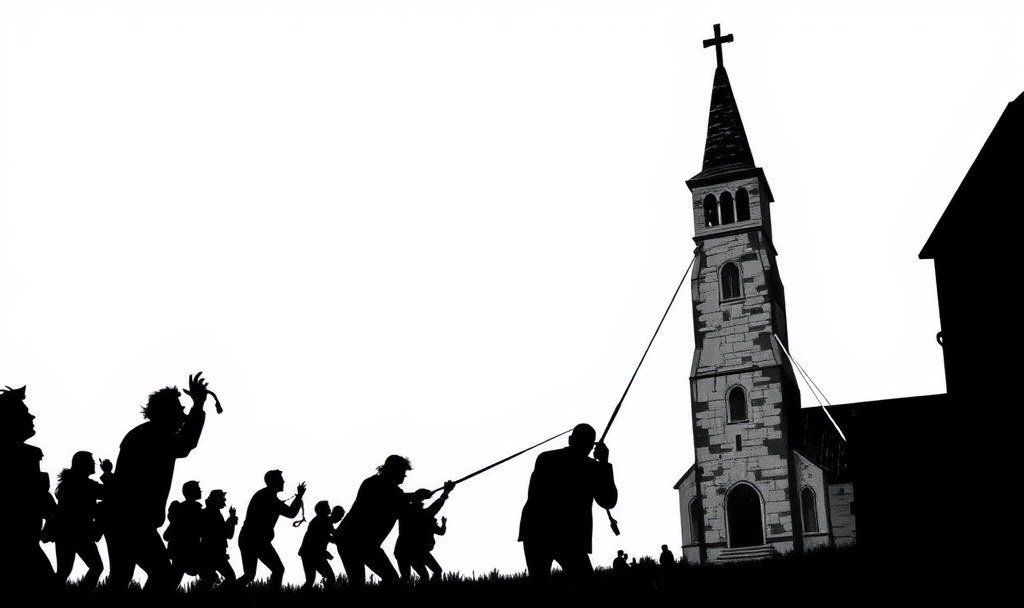
We’ve known for years now that the predecessor fund to the £11bn today held as the Church of England’s endowment was somewhat involved in the slave trade. This fund, known as Queen Anne’s Bounty, was both invested in companies which traded slaves across the Atlantic, and also took donations from people who had made money from owning and selling slaves, research has found (although, inevitably, this research is also contested).
In an attempt to make recompense for this, the Church Commissioners (who manage the endowment today, and fund a significant minority of the C of E’s activities) announced back in 2023 they would create a new investment fund. This would be seeded with £100m of the Commissioners money and used to invest in communities of descendants of African slaves.
This was deliberately set up not to be cash reparations, but instead a more one step removed effort to build up communities still struggling with the legacy of slavery, investing in education, healthcare, entrepreneurs and social justice. Unlike the rest of the Commissioners funds, which aim to generate as much return as possible (within ethical criteria), this fund will instead be focused on its social impact. The hope was that outside groups and individuals who also wanted to tackle the legacy of slavery would chip in and the original £100m would swell to up to £1bn.
An oversight group set up to guide its efforts called it the Fund for Healing, Repair and Justice, but somehow an earlier working title of Project Spire has become the label people use instead. And a label which has become pretty pejorative.
A growing group of Conservative MPs and traditionalist activists from groups like Save The Parish have landed on Project Spire as the symbol for everything wrong with the current C of E. The managerial, leftist elites who supposedly run Church House can find £100m to appease their consciences, frittering it away on woke boondoggles in the Caribbean, but they won’t give your local diocese enough money to keep St Swithun’s open or let St Cuthbert’s hire a new vicar, etc etc.
The line of attack they mostly utilise is not that they are necessarily opposed to an impact investment fund focused on recompense for the legacy of slavery. It’s just they don’t think the Church Commissioners can legally divert any money towards such a fund, because their charitable objects state its funds must be used to maintain ministry in the Church of England.
Some 27 Tory MPs and peers have now written to Sarah Mullally, the incoming Archbishop of Canterbury, to insist she shut down Project Spire and focus on “strengthening parishes” rather than on pursuing “high-profile and legally dubious vanity projects”. The letter states:
‘By law, the endowment must be used to support parish ministry, maintain church buildings, and care for the Church’s historic records. At a moment when churches across the country are struggling to keep their doors open — many even falling into disrepair — it’s wrong to try and justify diverting £100 million to a project entirely separate from those core obligations.’
Their argument is not entirely without merit: the Commissioners themselves agree that in order to start the fund, they will have to set up a new charity with new objects and then transfer the £100m to that. Charity law allows for such transfers if the trustees of one charity believe they are under a moral obligation. They are in the midst of in-depth conversations with the Charity Commission about how exactly they can pull this off legally.
The agitation in parliament is all being spearheaded by the Christian Conservative MP Katie Lam. She told the Sunday Times:
“This money was given to the Church to support parishes and priests, not to bankroll ideological vanity projects. Diverting £100 million away from its intended purpose seems an obvious attempt to rewrite the rules and laws governing charitable giving. If you give money to a charity, it must be used for the cause to which you donated, no matter how worthwhile other causes may be.”
The Daily Telegraph has also got in on the act, commissioning a poll of 500 churchgoing Anglicans (unclear if it’s a random and truly representative sample though) which found 61% would consider scrapping their tithes to the church if Project Spire goes ahead. More than four in five of those surveyed said the church’s money should support local parish ministry instead.
Others have also joined the fray, including the Anglican writer Bijan Omrani who said the proposals were a betrayal of those many Anglicans in history who actually fought to curtail slavery. Any moral debt incurred by British society during its centuries of slaving have been “amply repaid” by our nation’s later efforts to stamp it out.
But Mullally is having none of it. In her response to the letter, she said Project Spire would enable the C of E “to do the work to which Jesus has called it in more places, not fewer”. The church could not undo its shameful history, but it could decide how it responded to this:
“The Commissioners’ work is rooted in the Christian call to repentance, reconciliation and, above all, hope. It seeks to invest in creating a hopeful and positive future, using the lessons of the past and the prosperity of the present, for the benefit of the less advantaged among us now, and those communities which continue to experience the enduring consequences of historic injustice.”
Recognising the church’s complicity in slavery does not diminish the fact that many church people also fought vigorously to end it, Mullally also wrote:
“But as their example endures and inspires, so does our need to recognise the legacy of those evils they campaigned against.”
And, reiterating a point which has been made time and time again by the Commissioners, she said the £100m is not being taken out of funds earmarked for parish ministry. No diocese will be worse off financially because of Project Spire:
“Our calling to confront historic injustice and our commitment to sustaining parish life therefore both flow from the same Gospel imperative: to love our neighbour as ourselves and to enable all to flourish.”
The Church Commissioners also wrote a response, noting that their actions to investigate their historic links to slavery and then try to address them were in line with what responsible investors beyond the church were doing. And regardless of the precise regulatory hoops they had to jump through, creating the Fund for Healing, Repair and Justice was entirely in line with the C of E’s mission:
‘The £100 million commitment to a new in-perpetuity fund is consistent with the Church of England’s Fourth Mark of Mission: ‘To transform unjust structures of society, to challenge violence of every kind and pursue peace and reconciliation’. Moreover, it is not ‘reparations’ payable to the descendants of Transatlantic Chattel Enslavement. It is an ambitious proposal which seeks to bring about a more equitable future. As a Christian responsible investor, theological considerations are essential. A church that ignores our links with a fundamental historic wrong cannot credibly claim moral leadership in the present or the future.’
I’m no expert on charity law and wouldn’t pretend to understand the minutiae of how setting up the £100m fund can happen. But I find the basic argument against it more than a little specious. Do Lam and her other Tory colleagues honestly believe that the Commissioners’ billions can only be legally spent on paying vicar’s salaries and maintaining parish churches? That the hundreds of millions spent every year on things as diverse as youth workers, evangelism initiatives, school projects, bishops’ accommodation, curates’ training, energy-saving schemes, the General Synod, running the C of E websites, and much, much more besides has all been unlawful? Spending, by the way, that no Tory MP has ever shown a jot of interest in until suddenly the Commissioners decided they should make recompense for their history with the slave trade?
Marsha de Cordova, the Labour MP who acts as the liaison between the C of E and parliament, recently told the Church Times that she found the debate uncomfortable:
“We know that the church does have a historical link with the chattel enslavement of Africans. I think Project Spire… in terms of the Church atoning for its wrongs and its sins is absolutely the right way forward. To the critics, what I would say is, as somebody who has ancestors that were enslaved, I almost find it a little crass, frankly.”
I’m not accusing anyone of racism, but you do have to wonder why it is that investing millions into black communities is what has raised the ire of so many Tory parliamentarians. It just seems very convenient that we’re getting super involved in the nitty-gritty of charities regulation now, on this issue.
The church has always had a broad, sweeping view of what its role is. It’s always understood this as way bigger than just putting a vicar in every parish church. From time immemorial the church has spent its money on things beyond those narrow core objectives. There is legitimate debate about whether Project Spire is a good use of money or the right way to atone for the sins of the past. But let’s have that debate honestly and openly, rather than hiding our real feelings behind a facade of supposed deep concern over the charitable objects of the Church Commissioners.
Sanctuary
Most of you will be familiar, I suspect, with the ructions underway in the United States over the government’s severe crackdown on unauthorised immigrants. Teams of heavily-armed and masked agents from Immigration and Customs Enforcement (ICE) have been sweeping through cities across America in the last year, rounding up tens of thousands of people they believe are illegal migrants. Among those rapidly detained and deported have been American citizens, and others with legal rights to remain or protected status from the courts.
Some Christians and churches have been at the forefront of the mass movement trying to hamper ICE during their operations, as occasionally mentioned in this newsletter. Just before Christmas we had a Catholic church who amusingly removed Jesus, Mary and Joseph from its Nativity scene and replaced them with a sign reading ‘ICE Was Here’. And the Religion News Service profiled one conservative evangelical family in the Chicago suburbs who have thrown themselves into the grassroots efforts to monitor ICE raids and warn people in advance.
Of course, not all Christians are on the side of the migrants. Indeed, following the fatal shooting of one anti-ICE protester by an ICE agent in Minneapolis, progressives discovered the acting director of the local ICE field office was also an evangelical pastor at the Southern Baptist Cities Church in neighbouring St Paul, Minnesota. And so they decided to protest during a service on Sunday at Cities Church.
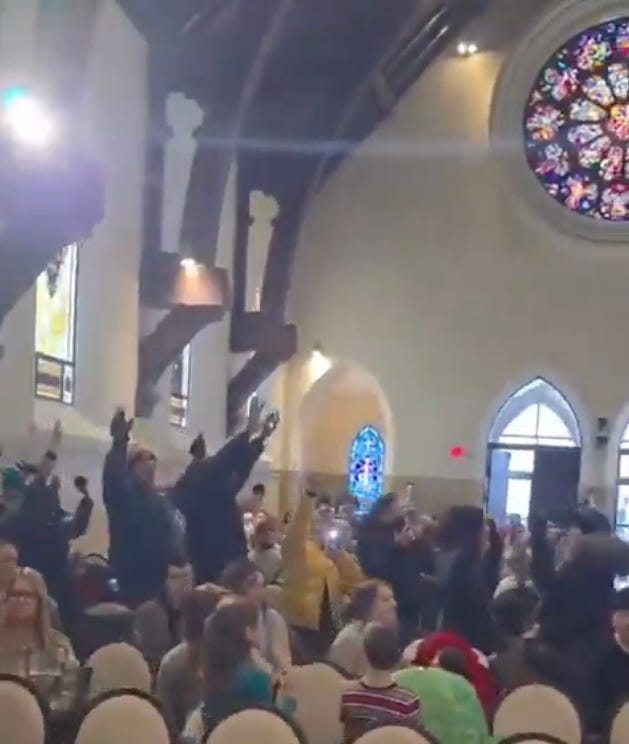
Video of some of the protest has been posted online:

“Justice for Renee Good”, a group of a dozen of so activists chanted during the service, referring to the anti-ICE protester who was killed earlier this month. The pastor leading the service (who was not the ICE official) shouted back “Shame on you, this is a house of God”, in response. According to a report in the Washington Post, the interruption lasted about 25 minutes.
David Easterwood, the ICE official and church pastor, came to the attention of the local anti-ICE activists when he was named in a lawsuit in December which accused ICE of violence and intimidation against pro-migrant activists. Documents filed in the court allege that the local ICE units “pepper sprayed, violently subdued, and aimed assault rifles at protesters and observers, and even followed observers home to scare them in a tactic lifted straight from the mafia”. Easterwood denied in the court filing that ICE agents had done anything like this.
The Sunday protest has triggered a major debate, however. One of leading protesters, herself an ordained minister and long-time civil rights activist called Nekima Levy Armstrong, gave a speech outside the church after the protest condemning Easterwood’s dual as ICE-pastor:
“How dare somebody claim to be a pastor while overseeing evil. Get your house in order! Don’t pretend to be a church while harbouring evil. Jesus — who they claim to worship — went into the so-called houses of God, he flipped over tables. ‘Cause he said, this is not my father’s house, I don’t care what you pretend. So that’s what we did today. We flipped over a table for truth, justice, and righteousness.”
Another local pastor, Lutheran Angela Denker, summed up the view of some progressive Christians when she wrote on Facebook:
“You cannot worship a Savior on Sunday who was crucified by a violent State, while the rest of the week acting as a violent agent of an unjust state force who is killing and targeting Americans according to hate. Christian Nationalism is diametrically opposed to the gospel of Jesus.”
The Episcopal Bishop of Minnesota, Craig Loya, gave a brief homily addressing the issue last week, before the church protest. He said Christians must resist meeting “hatred with hatred, anger with anger”, and instead should “turn the world upside down, by mobilising for love”.
But other Christians stand with Easterwood and Cities Church. Another evangelical pastor in Minnesota (and also a theologian at the well-known Bethlehem Seminary founded by evangelical mega-pastor John Piper) published a prayer for ICE online shortly after the shooting of Good.
Andy Naselli begins his prayer by thanking God for the ICE agents who are “bravely and honorably doing their job here in the Twin Cities of Minnesota”, and asks for their protection from “wicked men and women who are violent lawbreakers”, naming in particular the governor of Minnesota and the mayor of Minneapolis. He goes on:
‘We pray with the psalmist in Psalm 58:
“Break the teeth [of the wicked] in their mouths, O God;
LORD, tear out the fangs of those lions!
Let them vanish like water that flows away;
when they draw the bow, let their arrows fall short.
May they be like a slug that melts away as it moves along,
like a stillborn child that never sees the sun.”’
He ends by asking God to empower ICE agents to be “a terror to bad conduct… And please encourage them and enable them to be righteous avengers who carry out your wrath on wrongdoers (Rom 13:3–4)”. Other Southern Baptist leaders have strongly condemned the church protest too, accusing the activists of “desecrating” a sacred space and intimidating God’s people gathered to worship him.
On Tuesday, the lead pastor of Cities Church Jonathan Parnell (who was leading the service which had been disrupted) posted the church’s own response on its website.
‘On Sunday, January 18, a group of agitators jarringly disrupted our worship gathering. They accosted members of our congregation, frightened children, and created a scene marked by intimidation and threat. Such conduct is shameful, unlawful, and will not be tolerated. Invading a church service to disrupt the worship of Jesus — or any other act of worship — is protected by neither the Christian Scriptures nor the laws of this nation.’
Parnell added that his church solely sought to worship Jesus and share the good news about him, as Jesus offered the only final answer to the world’s “most complex and intractable problems”. Parnell also encouraged his church members to explain to their children that this is a time of “trial” and that they as Christians must embrace suffering for Jesus’s sake.
‘Church buildings are meant to be places of peace and solace, where worshipers can hear and live out this message. We therefore call on local, state, and national leaders to protect this fundamental right. We are evaluating next steps with our legal counsel.’
Others are already taking some steps, including the Justice Department which is investigating the Sunday protest as a potential civil rights offence. Harpreet Dhillon, the US government’s assisted attorney general for civil rights, was ferociously tweeting within hours that her team would be investigating this “desecration of a house of worship and interference with Christian worshippers” as a violation of the federal FACE Act (before then going on a protracted tour of the MAGA media and podcast-sphere and podcasts to drive home how seriously the Trump administration was taking this). Trump himself has called the protesters “agitators and insurrectionists… troublemakers who should be thrown in jail, or thrown out of the Country”.

Ironically, the Freedom of Access to Clinic Entrances (FACE) Act his law enforcement officials are hoping to use against the protesters was signed into law by Bill Clinton in the 1990s in response to a wave of Christian pro-life activism outside abortion clinics. It prohibits any use of force, obstruction or intimidation to stop someone getting into an abortion clinic. But, strangely, it also has a clause providing the same protection to anyone trying to exercise their rights of religious freedom in a place of worship.
It’s pretty clear the Trump administration are using this incident to whip up their base and pump up their pre-existing narrative about Christians being persecuted in America. Note their frenetic energy to pursue federal charges against Levy Armstrong (she was arrested yesterday, just days after the protest) compared to the total lack of interest in probing into the very murky shooting of Good (videos show she was driving away from the ICE agent when he shot her three times).
But you also have to note that there is no fundamental right to interrupt a place of worship for a political protest, on private property. Even if you sympathise with those Christians outraged by ICE (and pastors working with ICE), they are not going to win any more converts to their cause by angrily shouting in the faces of ordinary Americans in the pews who’ve come to church to worship God. It’s just bad politics, as well as unkind.
It throws the debate on “sanctuary” in a whole new light too. For years now, and expedited by Trump’s ferocious crackdown on immigration, some liberal churches have set themselves up as sanctuary churches, places where unauthorised migrants can find refuge, food, shelter, assistance with their legal status and more. For a time (before Trump scrapped it), ICE even had a rule that they would not carry out search warrants or detain wanted migrants if they were in sensitive locations such as schools and churches.
But that’s all gone by the wayside, as ICE smash down doors and scoop up children out of schools if they think they might not have the right papers. And even the term “sanctuary” is now being reclaimed by the right, who argue that churches should be sanctuaries from the now ubiquitous anti-ICE protests. Zones outside of the political to and fro, where nobody on either side dares to litigate their disputes.
But as Levy Armstrong told the Washington Post before her arrest:
“They want to act as if they’re upset about peaceful protesters coming into a church to try to engage in meaningful dialogue. But the flip side is that the Trump administration has removed guard rails around ICE being able to come into churches. Either the church is a sanctuary or it’s not.”
The tail is wagging the dog
On Wednesday, the agenda and documents for the upcoming General Synod of the Church of England were published. And so we can see the full detail of a story we’ve been tracking in this newsletter over the past year, revolving around the Clergy Conduct Measure (CCM).
As you might recall, this is the long-awaited replacement law on clergy disciplinary procedures which has been in the works since 2021 to replace the discredited and widely loathed Clergy Discipline Measure (CDM). To refresh your memory on why the CDM is so bad, you could re-read this previous edition of the newsletter. And to refresh your memory on how the CCM changes things, read this old Critical Friend.
Anyway, what you need to know is that after years of debates and careful line-by-line scrutiny in synod, the CCM was passed unanimously 298-0 in February 2025. And so it may be surprising to discover that the very same CCM is back on the agenda for next month’s synod, a year after it was resoundingly approved.
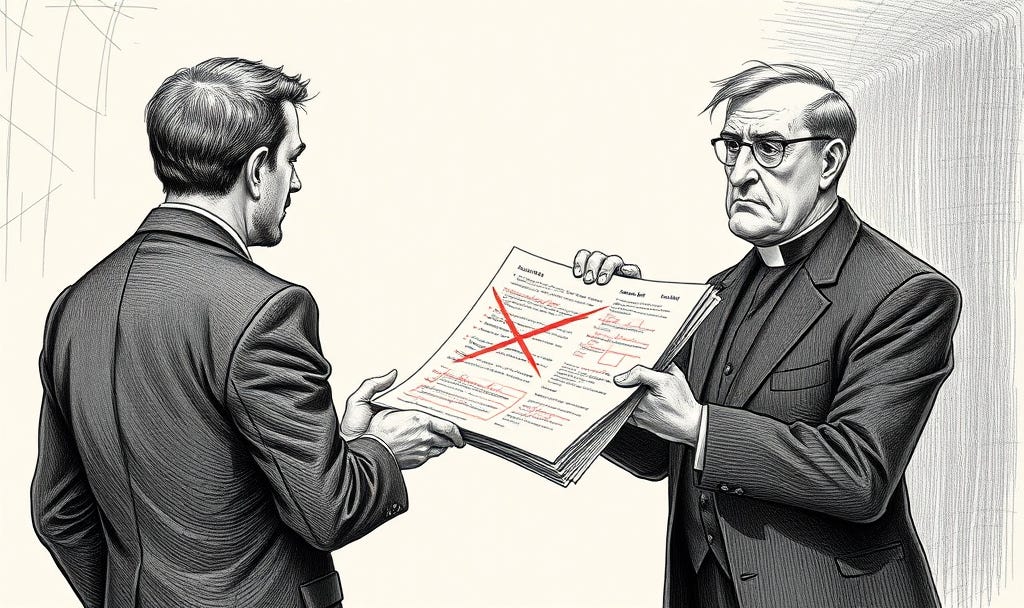
It’s back because parliament’s Ecclesiastical Committee doesn’t like it. Or at least, they don’t like one element that the CCM copied over from the CDM: that tribunal hearings are private by default. They can be opened up to the public and the media if the defendant priest wants it to be, or if the judge overseeing it decides it’s necessary for the “interests of justice”.
The Ecclesiastical Committee are a handful of MPs and peers whose job is to check over incoming legislation from the synod, and then recommend it on to parliament. Only when both the Houses of Commons and Lords have voted to accept a synodical act does it actually go to the King to be signed into law.
Ordinarily, the Ecclesiastical Committee basically nod on through everything sent them by the synod. But they do have the power to say a particular bill is “not expedient”: i.e. they do not think it should become law. This is exceptionally rare - the last time it happened was back in 2002. But they’ve done it for the CCM, refusing to sign off on it, arguing that tribunal hearings should be public by default (but with the ability to hold them in private in certain sensitive circumstances).
This presented a dilemma for the synod. It could either abandon the entire CCM legislation, which would have been a catastrophe, wasting years of hard work and leaving the CDM in place for another generation. It could have tried to overrule the Ecclesiastical Committee and insisted the CCM as passed was laid before the whole parliament (and hoped the lack of sign-off would not spook MPs and peers into voting it down).
Or, it could take the easier road and bring the CCM back to the synod, amend it along the lines the Ecclesiastical Committee wanted, and then send it back. Which is what they will do next month - speedily insert an amendment which makes hearings public by default, and pass it back to parliament.
This is probably the sensible, lowest-risk thing to do, to ensure the rest of the CCM’s helpful reforms come into force. It will apparently only delay the whole thing by about six months in the end. But it also raises some troubling questions about how the church is run.
Because this precise question - should hearings by public or private - was extensively debated on the floor of the synod years ago. The democratically-elected representatives of the C of E thrashed it around and concluded overwhelmingly they thought private hearings was a better option. And so what we really have here is a small group of self-selected parliamentarians getting to overrule and boss around the 400-odd elected governing representatives of the church. Some of those on the Ecclesiastical Committee aren’t even Anglicans. One of them is a hereditary peer who only gets into parliament at all because of who his dad was (although not for long, thankfully).
Is this right? Is this fair? As it happens, my sympathies on the particular issue lie with the committee. I think it’s probably a better position to have hearings public by default, but with the power to hold them in private if that is necessary to encourage witnesses and others in sensitive cases. But bigger than this issue is the question of who should be in charge of legislating for the entire denomination: its own elected assembly, or 30-odd busybodies from another institution entirely?
Because the other issues the committee had with the CCM suggest this is not a group with penetrating insight, grasping problems the morons on synod failed to spot. Alongside their complaints about the private hearings, they also whined that the synod didn’t show them the rules (secondary legislation which will oversee how the CCM is implemented). And yet secondary legislation which has not even been passed yet by the synod (as it’s dependent on the CCM first) is not within the remit of the committee and never has been. Obviously rules which haven’t been written yet cannot be shown to the committee.
The parliamentarians also raised concerns about whether clergy would be protected from vexatious or malicious complaints. This is a real issue - one of the primary ways the CDM has failed is that it is very easy for cranks to persecute clergy via malicious complaints which even if baseless can take years to resolve. But, but, but. This obvious problem has already been clearly addressed by the CCM: there’s a whole section about how vexatious complainants can be barred for life, plus an extra filter when complaints are first made which is supposed to stream out complaints which obviously lack any merit.
Did the committee even properly read the bill they’ve just declared to be “not expedient”? Is this really a scrutinising body superior to the synod itself, one which gets to dictate what legislation the synod can and cannot pass? Or is this a group of MPs and peers who have got nobbled by some campaigners behind the scenes and are flogging their hobbyhorses regardless of the actual legislation before them?
As well as batting back the CCM, the committee has indicated to the synod it also won’t sign off another major piece of reform: the National Church Governance Measure (NGCM, discussed in a previous newsletter). As with the CCM, its objections to the NCGM don’t really stack up, and are suspiciously close to the talking points of the Save The Parish pressure group. And so, having gone over two decades without feeling the need to refuse sign-off for a synod act, last year this Ecclesiastical Committee, like the proverbial London bus, has done it twice in a row.
So either the synod has suddenly dropped the ball and started passing legislation filled with holes and problems. Or, perhaps more likely, this particular incarnation of the Ecclesiastical Committee has become unusually intransigent and has decided to use their obscure role in the constitutional arcana around church and state to relitigate some culture war stuff. My instinct leans towards the latter.
The tail is, without a doubt, wagging the dog. How can it be appropriate that a small coterie of parliamentarians can repeatedly interfere with a religious denomination’s internal laws to their own ends? Would we tolerate parliament sticking its nose into how the Methodists organised their institutions? Would it be remotely acceptable for MPs to overrule how the United Synagogue thought it should manage rabbis who break the rules? Has the time not come to grant full self-government to the C of E?
If that requires full-blown disestablishment of the church than so be it, I say. But I don’t even think you’d need to go that far. It shouldn’t be impossible for parliament to just let synod legislate for itself, and stop presuming it knows better.
What makes the church vulnerable to abusers?
Abuse has been exposed in every corner of the church in recent times, but the evangelical tradition has been particularly badly hit with a litany of respected leaders revealed to have been prolific abusers. One of the worst was John Smyth, but the official Church of England investigation into him including a fascinating appendix from Elly Hanson, a psychologist who specialises in abuse. Elly unpicked not just the psychology of why Smyth sadistically beat dozens of young men in his garden shed, but also the weaknesses and vulnerabilities in the evangelical sub-culture which he exploited: hierarchies, loyalties, patriarchy, alongside assumptions about the nature of sin and repentance. In this episode she joins us to talk through her conclusions, and discuss whether evangelicalism can be purged of its risky communal practices and made safer, without losing its fundamental theological convictions.
Quickfire
I’ll be honest, I only had to read the headline of this article from the AP news agency to know it was getting a mention in The Critical Friend: ‘Priest by day, DJ by night’. Portuguese Catholic priest Guilherme Peixoto has carved out a ministry as a priest-DJ, and now performs to huge crowds at raves around the world. But his performance in Lebanon has sparked an angry backlash from some Christian leaders there, who say his events insult the faith.
A Catholic diocese in Poland has triggered international headlines after it banned its parishes from playing the Ed Sheeran song ‘Perfect’ during weddings. The authorities in Włocławek said churches must only use sacred music, and even banned a Polish band from playing in churches after they performed a Christianised version of Perfect with new Polish lyrics.
The Association of English Cathedrals is running a competition to find England’s best-loved stained glass window. See them all and cast your vote here — personally, I always love a rose window so might go for St Albans.
About 160 Christians were abducted from church services in northern Nigeria during three simultaneous attacks on Sunday. No group has yet claimed responsibility, but kidnappings like this have become commonplace in remote, rural and lawless parts of Nigeria where armed militias roam freely.
An unexpected item of church furniture has sparked another front in the Catholic Church’s endless culture war in America. A bishop in North Carolina has issued a rule instructing all parishes to remove kneelers and compel worshippers to stand while receiving communion. Apparently, this is all part of the effort to push back against traditionalist folk who want to undo the reforms of Vatican II and go back to the old Latin Mass (which included receiving the host while kneeling). The diocese says it’s trying to enforce universal Catholic norms, while some more conservative priests have questioned if the bishop has the authority to tell them how to run communion.
A former soldier and now vicar in the C of E has appeared on the TV show Gladiators. Rachael Phillips, a curate in Durham, was narrowly defeated in what Premier Christians News described as a “dramatic head-to-head eliminator during Saturday night’s episode, after taking on a series of elite Gladiators”. As she entered the tournament, Phillips said in the inimical style of a priest going onto a reality TV show: “At the centre of my faith is that Jesus showed us mercy, but on Gladiators, I’m going to be showing none.”
The Church of Sweden has warned parishes against working with a convent of nuns who are fundraisers for and strong supporters of Russia’s war in Ukraine. The sisters of St Elisabeth’s convent, in Belarus, have been inserting themselves in as many as 20 churches in Sweden, ostensibly selling trinkets to the faithful. But, the Church of Sweden has now revealed, they actually have links to Russian military intelligence and are part of a propaganda campaign by Russia. Nuns from St Elisabeth’s are famous for posing with the infamous Z symbol of Russia’s invasion and have been seen donning flak jackets to encourage Russian forces inside occupied Ukraine (activities which led to them being banned by Winchester Cathedral once the war began in 2022).
A Catholic priest and former head of the Jesuit Order in Britain has been made to resign from Oxford University’s Catholic chaplaincy after a student made a complaint against him. Damien Howard, who previously led the Jesuits between 2017 and 2023, was investigated after the safeguarding complaint was made, and forced to stand down once the Jesuits substantiated the allegations, which they described as “unacceptable and inappropriate behaviour”.
The heads of churches in the Holy Land have issued a statement reiterating their opposition to the “damaging ideology” of Christian Zionism, and demanding Israeli leaders engage with their traditional authority alone rather than outside Christian voices who are more pro-Israel. This has prompted a rebuttal from the American ambassador to Israel, former pastor Mike Huckabee, who oddly decided to wade in and chastise the patriarchs and archbishops for failing to see that supporting Zionism was intrinsic to Christian faith.
A brilliant story from Norfolk, where councillors wondered aloud if a tiny church’s plans for a new building had sufficient space for parking given the Quiet Revival. Dereham Gospel Hall Trust wanted to tear down and rebuild its church, which hosts about 40 worshippers each Sunday, with a similar size but modern building. But one councillor asked if the church’s new entrance could cater for a huge influx of new members should the Quiet Revival finally hit East Anglia. Nevertheless, the council approved the plans unanimously.
Thanks for reading. I’d really appreciate it if you could share The Critical Friend with someone who doesn’t yet read, and also consider if you could become a paying subscriber for just £5 a month. This also gets you access to the full back catalogue of posts, the comments section, and occasional bonus material too.
"I’m not accusing anyone of racism, but..." you say. As a person mentioned in this article, I'm very glad to hear it. One hopes that you aren't going to insinuate such an accusation in response to well-evidenced concerns are adduced about the moral, historical, legal and practical basis for Project Spire.
These concerns are legion, and have been written about in many places, but one might mention a few here:
1. The investment of the Queen Anne Bounty was in government securities, not the slave-trading arm of the SSC; there was no profit from those activities;
2. Mullally's statement may claim that they pay regard to the work and sacrifices of the Church and its members who fought against slavery, who gave up treasure and in many cases their lives in the struggle, but if these sacrifices are not acknowledged in the financial calculus of Project Spire, then this claim is just words;
3. The moral objection of the distance between the actual victims of slavery two centuries ago and those who will actually benefit from the £100m today (as raised by Nigel Biggar in his book "Reparations") remains unanswered; It does nothing to combat actual slavery which is still practised today in large parts of Africa and Asia, not to mention even within the UK itself;
4. Donations to charities are given for particular purposes, and it is unjust to alienate those donations to other and quite different purposes against the will of the original donor or purpose of the charity when that purpose still exists and can be fulfilled; it is spurious to say that the £100m belongs to a different pot and that it could never benefit the poor parishes and clergy who are still calling out for this support, as the money is fungible;
5. Spire actually works against the Church's Fourth Mark of Mission: ‘To transform unjust structures of society, to challenge violence of every kind and pursue peace and reconciliation’. It is unjust and divisive as it allots the spending of money and capital on the basis of skin colour, not actual need and merit. It will serve to set people against each other, rather than bring them together.
The 'forensic accountants' did not understand history. They wrongly claimed that QAB had invested in the slave trade (it did not; it invested in government bonds). When this was pointed out, the CC rewrote their claim without admitting it. The idea that you can trace those affected by slavery is implausible. Slavery was indigenous to African culture, not invented by Britain. Britain invested billions in, uniquely, combatting slavery. Other damaging involvement by the Church (eg the oppression of the Irish) doesn't seem to count. The fund is doing nothing to tackle the real issue—modern slavery. The CC have failed to consult as promised. The whole thing is almost certainly illegal under charity law. And it is deeply divisive in parishes.
But apparently to mention any of this is either petty or racist. Seriously...?!