
In the grey zone
Conservative would-be breakaway Anglicans baulk at the fence yet again, while the police can't seem to stop raiding the Quakers

Hello! Our first story today is about Gafcon, that conservative Anglican network who have long angrily opposed their more liberal Western Anglican cousins over the issue of same-sex relationships. Last week was supposed to seal their kind-of-but-also-kind-of-not schism, but instead the limbo will linger on it seems.
Then we try to find out why the Metropolitan Police have raided a Quaker meeting house for the second time in a year.
Lastly, is the explosion of online misinformation generated by AI a huge threat to the church, or actually an opportunity?
There’s also our latest podcast (Are men really coming back to church?) and lots of links to interesting church news stories from around the web, including this week the oddest location for a Christian retreat centre, a breakthrough for UK gospel music, and Stephen Cottrell tells off the BBC.
In the grey zone

The last time we checked in on the Anglican Communion, that family of 40-odd related but independent churches around the globe, things were looking a bit dicey. Gafcon, the conservative protest movement, had appeared to launch a schism, announcing they were unilaterally “reordering” the Communion around their own principles and setting up the “Global Anglican Communion”. They had already rejected the authority of the Archbishop of Canterbury (the traditional spiritual head and ‘first among equals’) back in 2023. Now, they claimed to be finishing the job by orienting Anglicanism solely around their conservative Biblical beliefs.
Gafcon member churches (the membership is a bit fluid, but it’s roughly a dozen or so official denominations plus a further handful of breakaway new Anglican churches) were ordered to fully cut ties with all official Communion bodies and refuse to take any money from the central Communion office. And, perhaps most notably, there was a pledge to meet and elect a Gafcon archbishop as their own ‘first among equals’.
As ever, the presenting issue was sexuality. Gafcon was born in 2008 in the wake of a crisis prompted by American and Canadian Anglicans consecrating gay bishops and creating liturgies to bless same-sex couples. And the final straw now, almost 20 years later, seems to be the Church of England’s own gay blessings and the selection of Sarah Mullally (who is pro the Prayers of Love and Faith) as ABC , and therefore also the de facto head of the Communion.
As we dived into last time, Gafcon were being quite vague (and perhaps even economical with the truth) about whether this was a true schism-schism, or just more manoeuvring. Sometimes Gafcon people said this was it, the big one, we’re leaving. Other times, no we’re not going anywhere, this is our Communion, they left us etc. It was genuinely difficult to discern what the announcement actually meant. Some five months later, I think we are starting to get some clarity.
Last week Gafcon leaders met in Abuja in Nigeria to elect their own rival to the ABC, the leader of their putative Global Anglican Communion, to put the seal on their supposed schism. Except, as they often do, they baulked at taking such a step and in the end did not choose a new ‘first among equals’. Instead, Gafcon will be led by a new council of primates (the head archbishop of each Anglican church), clergy and lay people called the Global Anglican Council.
In the letter announcing this, it was presented as a positive choice not to replicate the old Canterbury-centred Communion:
‘This expanded Council reflects the willingness of the Primates to share their authority with a wider group of global Anglican leaders, both lay and clergy. While the Chairman of the Council will be a Primate, he will not be primus inter pares (first amongst equals).
Believing that the current Instruments of Communion no longer meet the needs of the majority of Anglicans around the world, the Global Anglican Communion is to be led by a conciliar structure. The Global Anglican Council has discerned that if we are to move past old structures, we must leave behind old titles as well.’
They then elected the same two primates who had led the previous top Gafcon body — Laurent Mbanda of Rwanda and Miguel Uchoa (who leads the breakaway province in Brazil) — as chair and vice-chair . The announcement made much of the primates generously choosing not to hoard their authority by setting up parallel hierarchical structures for their Global Anglican Communion, and instead “sharing their stewardship” of the movement with more junior bishops, clergy and even lay people, each with “full voting privileges”.
This abrupt volte-face caught most of the press pack who had trekked to Abuja to cover the dawning of a new proto-denomination on the hop. This BBC story captures some of the evident confusion, as even the Gafcon spokesperson struggled to really explain what this meant in practice. Did Gafcon now acknowledge the overarching authority of Mullally as ABC then? Umm, not sure - they accepted that Mullally was the ABC, but said the Global Anglican Council would only look to Mbanda as leader. Except I thought he wasn’t its actual leader, just chair of a conciliar structure which was sharing power around?
This wasn’t really about sexuality also, the spokesperson insisted, it was about deeper disagreements over doctrine. Although, also Gafcon didn’t like the fact Mullally was a woman as apparently most Anglicans worldwide believe in male-only bishops (a statement which completely ignores the inconvenient fact that even some Gafcon-member churches such as Kenya have ordained women as bishops).
You can see the confusion simply by looking at the contrasting headlines. The BBC went with ‘Conservative Anglicans pull back from electing rival to Archbishop of Canterbury’ while Reuters had ‘Conservative Anglicans challenge Archbishop of Canterbury with rival leadership’. Hang on — is there a rival to Canterbury’s leadership or not? Whatever this is, it’s not a well-executed communications strategy.
Even the conservative Anglican Ink blog, which is well connected with Gafcon figures, was openly wrestling with what the Abuja about-face meant:
‘A late night “movement of the Holy Spirit” led the leaders of Gafcon to shelve plans to elect a primus inter pares – first among equals – adopting a conciliar or committee style of leadership for conservative Anglicans – and to downplay the name Global Anglican Communion, rebranding itself as the Global Anglican Council.
The decision to avoid a confrontation with the Archbishop of Canterbury and the Anglican Communion by not setting up rival structures perplexed the delegates, as the u-turn in structure and strategy appeared without warning.’
Once again, we’re back in that grey zone somewhere between full on schism to set up a rival communion and begrudgingly continuing within Canterbury-aligned structures. Once again Gafconners had been marched up the hill only to be let down by their leaders ducking the confrontation with Canterbury,
Beyond that, there’s also the fact that if we’re going to be nit-picky, traditional Anglican ecclesiology doesn’t really involve conciliar leadership. Yes, there have long been assemblies and synods which include priests and lay people, but every Anglican church is still fundamentally a hierarchy which is led by bishops and bishops alone, and indeed by a single archbishop at the top of the tree. So it is all a bit weird for a group which says it is determined to bring global Anglicanism back to its traditional roots and away from all that nasty liberal innovation, to then set up a leadership structure which seems to be a bit un-Anglican.
When the Abuja gathering ended, we did get a smidge more clarity thanks to a lengthy communique published by the Gafcon leaders, which they are calling the Abuja Affirmation. This begins by relitigating the traditional Gafcon complaints: for 20 years they have been calling the Communion back from its un-Biblical apostasy over sexuality issues, but the formal authority structures (including the ABC, the Anglican Consultative Council (ACC) and the Primates’ Meetings) have failed to rein in the liberals. These institutions have simply held together a “confused communion of institutional co-existence, based on the fiction of ‘walking together’ with those who are walking away from the truth of the gospel and the teaching of Jesus”.
Instead, the Bible in its “plain and canonical sense, respectful of the church’s historic and consensual reading”, must be the only foundation of the Anglican Communion. But the official Communion and indeed Mullally herself have abandoned this by endorsing gay blessings and by welcoming in gay bishops:
“The moral and spiritual authority of the Seat of Augustine has been severely compromised by this. The ACC and the Primates’ Meetings have neither restrained nor challenged false teaching and instead have called for the acceptance of false teachers as fellow members of the Communion.”
The statement acknowledges there will continue an Anglican Communion which defines itself on an “institutional basis” — i.e. the official body which recognises as members any church which is in communion with Canterbury. But true communion must be founded not on shared institutions or history, but on a shared confession of truth, Gafcon argue:
“There are not two Communions, but two incompatible definitions of communion – one confessional, the other institutional. The Global Anglican Communion is neither a breakaway Communion nor an alternative Communion. The Jerusalem Statement clearly says that “We cherish our Anglican heritage and the Anglican Communion and have no intention of departing from it”. What has occurred instead is a shift of the stewardship of the Anglican Communion from the Canterbury Instruments to the Global Anglican Communion. We are returning the Anglican Communion to its roots. The Global Anglican Communion is not a new Communion, but the historic Anglican Communion reordered from within.
If you want to be a leader in the new Gafcon-led communion, however, you must not attend any Canterbury-led meetings, the communique goes on to state. There is slightly softer language about money, where it is only “expected” that Gafcon-aligned churches do not take money from “compromised sources”. This is so that mixed provinces (i.e. official Anglican churches which have both pro and anti-Canterbury elements in, such as the Anglican Church in Australia) can still be legit Gafconners.
This bit is trying to tread a fine line. There are inner and outer circles in Gafcon; some provinces have been de facto boycotting all Canterbury-led Communion stuff for years already, while others want to have their cake and eat it. They do Gafcon stuff but they also keep open links back to official Communion institutions too. The hardline Gafcon inner circle want to force their less intransigent colleagues to pick a side, but without booting out those like the conservative Australians who are full-throated Gafcon in heart but marooned inside a more liberal denomination still aligned with Canterbury (and perhaps also even give comfort to some English prelates facing a similar situation?).
They do in fact address this later on, again trying desperately to maintain the broadest possible coalition. Gafcon is in favour both of those who stay within “revisionist” churches and those who decide they cannot remain and break away to form new churches, the statement says:
“Gafcon has always acknowledged that it is a matter of conscience, when rejecting the authority of revisionist leaders, as to whether one remains or not in a compromised ecclesial structure.”
What is odd about this is that just a few paragraphs up they have had a lot of bombast about the impossibility of remaining connected to those promoting false teaching, and the Biblical imperative of cutting off ties to people who have abandoned the true gospel:
‘A full and public disengagement from these structures is necessary. The clear and consistent teaching of the New Testament is that those who seek to lead the church astray must not be tolerated and Christians must refuse to have fellowship with those who promote false teaching… The warning of the prophet Amos rings true: “Can two walk together unless they are agreed?”’
Isn’t this a little contradictory? We’re being told it is impossible for truly orthodox provinces to remain even vaguely aligned with occasional meetings of the Communion’s international bodies if they want maintain their integrity. And yet is apparently absolutely fine for truly orthodox priests or bishops to stay full and integral parts of the Church of England, the very body whose blessings for gay couples are what have precipitated this crisis?
Again, this is where politics is taking precedence over conviction. It would be damaging to the Gafcon coalition if they forced the issue and insisted all true Anglicans stuck inside liberal provinces quit and started new denominations, as lots of their strongest supporters are in fact conservative parishes in places like England or Australia. So they fudge the issue and tie themselves up in knots.
In the end, despite all the sound and fury, we’re basically exactly where we started from. Gafcon continue to duck the issue, and live in the grey zone — neither fully in nor fully out of the Communion. They want all the press coverage as though they are breaking away or rivalling Mullally for leadership, but they’re not yet prepared to actually follow through their convictions and do it for real. Their coalition is still too much bound up in official Anglicanism for it to work as a fully independent movement, so they can’t yet walk away for good.
Their clear preference is not to make the Global Anglican Communion its own thing, fully separate from the Canterbury Communion, but instead to try and take over the official Communion from the inside. But they don’t really have any mechanism to do that. There are no elections for the ‘first among equals’ they could campaign for. There is no transnational governing body they could wrest away from the liberals to dictate a return to conservative orthodoxy. Because Anglicanism isn’t really a thing — it’s 42 entirely autonomous churches choosing to hang out and do stuff together occasionally because they have a shared history.
It’s not like being a conservative parish in a liberalising C of E. There it is crystal clear if you are in the church or out of it. It’s a binary, black and white issue (despite the numerous efforts by the conservative Alliance anti-gay blessings network to try and fudge the issue in their campaigns against the Prayers of Love and Faith). As long as your church is led a vicar who is licensed by the local bishop, you are part of the C of E, whether you like it or not.
But the international picture is nothing like that. Indeed, in many ways the Communion is currently trying to make things even more loose and vague, to make it easier for independent churches with very different theologies to still be able to share space inside international institutions. These are the so-called Nairobi-Cairo Proposals, which have been slowly gestating over the last couple of years (we covered them in the newsletter last year).
In fortuitous timing, just last week the committee pushing them forward published its latest thinking in a new paper. The core idea is to subtly dislodge the C of E and the ABC as the lodestar around which the Communion revolves. It’s about shedding “the baggage of colonialism” and making the “Communion’s leadership look like the Communion”, but while still “celebrating a shared theological and sacramental inheritance, to which the ministry of the Archbishop of Canterbury bears witness”.
They are sticking with their two core ideas from 2024: redefining the Communion as churches which have a historic connection to the ABC (but not necessarily in full communion right now with Canterbury), and saying its churches “seek” to uphold the faith set out in the Book of Common Prayer. These two tiny tweaks, they hope, will give more space for conservative churches to redefine their own ties to Canterbury (without entirely breaking them) and allow different churches to interpret the gospel in their own way, again without coming to blows over whose interpretation is the sole normative one.
Other ideas have been watered down, however, such a rotating presidency of the ACC (a triennial gathering of representatives from each member church) which was proposed in 2024. Instead, the ABC would be asked to bring together a council of regional primates to “share his or her ministry in the Communion in a collegial way”, and the role of ACC president (already largely ceremonial) would be simply abolished.
It’s still, I think, positive stuff — but very timid. The committee make the point several times that the C of E is not the mother church of the Communion any more, just one of many sister churches. That not everything has to be done by or on behalf of the ABC any more. So why not just follow these conclusions to their natural resting place, and replace the ABC with a rotating or elected president of the whole Communion. If this is genuinely a family of 42 equal churches, why is the head of only one of them given special priority (especially when we are no longer requiring the other 41 churches to even be in full communion with that archbishop anyway)?
None of this inching towards greater mutuality within the official Communion structures is going to cut the mustard with the would-be schismatics of Gafcon. And I’m pretty sure everyone knows that anyway. Nobody in the Inter-Anglican Standing Commission on Unity, Faith and Order (the peerlessly-named committee pondering these reforms) is under any illusions these moderate tweaks will bring Gafcon back into the fold.
We have now had 20 years of thunderous denunciations and ultimatums from the conservatives, without much really changing on the ground. Gafcon know full well the other side are not going to rip up the Communion or expel the liberals just to appease a conservative minority. And the official Communion lot know full well Gafcon are not about to back off from their positions because of some minor revisions to the definition of Anglicanism. There is not going to be a meeting in the middle here. It really is time to put up, or shut up — very little is going to be achieved by yet more rounds of ambiguous threats of quasi-schism.
The best commentary I’ve read on this increasingly frustrating stalemate came in that BBC article I linked to above. It quotes Anthony Poggo, the secretary-general of the Communion, explaining there are clear mechanisms to formally quit the network but that none of the Gafcon churches were actually prepared to do this:
‘“We need to go through our existing processes, namely, a standing committee, or the synods that we have in each of the provinces, rather than doing it outside of these processes.”
So what happens when one part of the family refuses to do so, but behaves as if it has left?
“There is not much you can do,” concedes Bishop Poggo, adding: “It saddens us.”’
Property is theft

Just under a year ago, the Metropolitan Police raided a Quaker meeting house in central London to arrest a group of activists planning some non-violent protests. This prompted lots of coverage, some of it scandalised the police would desecrate the sanctity of a place of worship. Clearly, not much of that bothered the Met, because last week they did it again.
On Thursday evening last week, officers burst into the Westminster Meeting House and arrested 15 activists from a group called Take Back Power on suspicion of “conspiracy to commit theft”. The police claim they were planning a campaign of mass shoplifting, stealing things from the shelves of supermarkets to later redistribute to others. One man was bailed, and 14 others taken into custody.
It’s not quite true to say that the Met were unruffled by the backlash to their previous raid on the same Quaker meeting house in April, as their press release announcing the arrests includes some comment from a very senior officer, deputy assistant commissioner James Harman:
“I know that a similar operation at the same Quaker Meeting House last March, which saw the arrest of a number of Youth Demand activists, attracted some concern. While we reflected carefully on those previous concerns before approving tonight’s operation, and took steps to ensure we caused minimal disruption, we ultimately felt we had no choice but to act. We cannot get into a situation where groups planning criminal acts can escape police action simply by booking rooms in certain venues.”
The police’s argument is basically that crime is crime, no matter if it is politically-motivated. If they find out you and some friends are planning to break the law, they will come to arrest you, whether if you are making plans in a place of worship or not. Unsurprisingly, the Quakers see it somewhat differently. They were not directly involved with the activists of Take Back Power, who had hired the room, but were not prepared to simply stand by either. Oliver Robertson, head of witness and worship for Quakers in Britain, said:
“For Quakers, faith and action are inseparable. Peaceful protest, prayer and nonviolent action are integral parts of many Quakers’ religious life. Whilst we take the planning of criminal acts very seriously, we believe that this incident is a deliberate targeting of committed young people who want to make our country a more equitable place. This raid is part of a systematic stifling of dissent.
“That this is the second time in a year that the police have raided our meeting house dramatically illuminates the broader trend in the UK of cracking down on those who disagree with the government. The right to protest is fundamental to our democracy. It’s a key part of how people make their voices heard between elections.”
There was lots of discussion last year about sanctuary and the special sensitivity of places of worship, which I won’t bore you by relitigating again now. In fact, it’s interesting that the Quaker response doesn’t really go into this at all, instead focusing not on the inviolability of their buildings but the sanctity of their belief in non-violent protest.
So, in their eyes, the real debate is not whether places of worship should be sacrosanct, but whether Take Back Power are a legitimate protest movement trying to make the country more “equitable”, or a group planning a mass shoplifting campaign. I don’t really know the answer to that one — Take Back Power’s website says their core demand is for the government to replace the House of Lords with a citizens’ assembly which would be empowered to massively increase taxation of the super-rich. But they do acknowledge they are going to try and achieve that not with petitions or marches or online campaigning, but through “disruptive” direct action:
“History shows us that disruption is a necessary part of social change. Disruptive direct action brought us livable working conditions, the weekend, universal suffrage, and civil rights for marginalised communities. More recently, it saw the demand of Just Stop Oil become government policy. The evidence is clear that though people may not like the messenger, or the method of delivery, they hear the message. Ultimately this leads to political pressure and eventual social change.”
Last year, Take Back Power activists were behind a stunt where they threw apple crumble and custard at the Crown Jewels (safe in their protective case) in the Tower of London, and also dumped manure outside the luxury Ritz hotel. I’m not personally entirely clear how these actions are getting us any closer to their tax-the-rich citizen’s assembly, but your mileage may vary.
One person’s disruptive protest is another person’s criminal damage, of course. But it is true that since the recent wave of direct action by groups like Extinction Rebellion and Just Stop Oil, the previous Conservative government did give the police vaguely-worded and much tougher powers to try and pre-emptively stop people they think might be planning this kind of protest. And the police don’t have a flawless track record of always using these powers wisely.
Then again, if the Met’s intelligence is right (and it could of course be total rubbish) and Take Back Power were really planning a campaign of mass shoplifting, it’s hard to argue that is anything other than criminality which has to be prevented by the state. Becoming a 21st century Robin Hood may well be, for some of the more Quaker-ish parts of Gen Z protest movements, a deeply religious act, but it is also a crime.
If Daniel had an iPhone

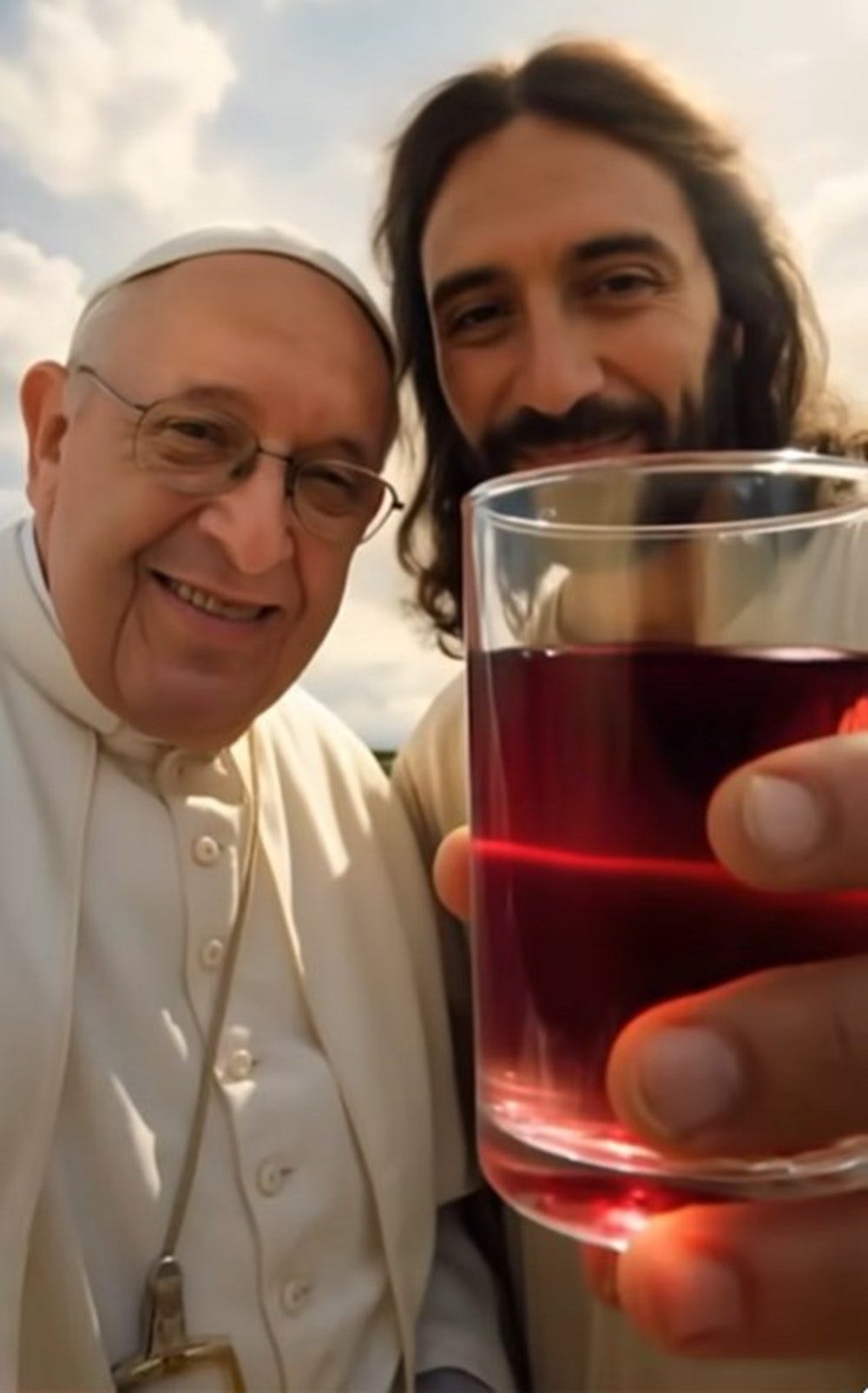
Pope Francis smiles warmly as he stares into the camera, his arm around the shoulder of a bearded, long-haired man in white robes. The man, also smirking, holds up a glass of water and as the camera rolls the crystal-clear liquid turns a deep, rich wine red. Soon, Francis is repeating the miracle himself, before the video cuts to the pontiff, traditional papal garb billowing in the wind, soaring through cloud-flecked skies next to who we now realise is a suspiciously European-looking Jesus. In the background, ‘Knockin’ on Heaven’s Door’ by Bob Dylan plays.
The title of this bizarre 60-second video – which has been viewed 26 million times on TikTok – is “Jesus performs miracles in Heaven with Pope Francis”. And just beneath that TikTok have appended an extra caption: “Creator labelled as AI-generated”.
On another social media platform, Facebook, scrollers were confronted with an “Urgent message” from “Edward and Helen’s parish”. In a selection of photos attached to the post, a kindly if wizened elderly couple painstakingly put together a craft project in a workshop they’ve apparently built inside their home.
Edward and Helen mournfully inform the people of Facebook that as their hometown of Bradford has changed their church dwindled to a handful of congregants. The diocese is threatening to close the parish down, probably so it can be turned into a mosque.
The post also includes two photos of their precious church; one in black and white from its bygone glory days, and another colour image of its present situation, hemmed in by looming blocks of ominous-looking council housing. But there is a chance to keep the doors open – if only Edward and Helen can raise £18,000 a year. So please buy their Christian nativity sets, crosses, ornaments and more: “Every item handmade, signed and guaranteed for your lifetime. Made while we’re still able.”
In truth, the website Edward and Helen linked to was not run by a sweet elderly Yorkshire couple, but was a generic online storefront selling mass-produced Christian trinkets. Edward and Helen do not exist, and neither does their mythical Bradford parish supposedly overrun by Muslims. Unsurprisingly, this shameless scam is very much not labelled as “AI-generated”, even though the images (and very possibly the text as well) had definitely been made by a machine.
Earlier this year the Church Times asked me to look into the proliferation of AI-generated misinformation and disinformation online. This is not a necessarily new issue, but it’s big enough now that it’s starting to affect the church’s own little online niche too. One of the first examples to cut through was a photo of Pope Francis in the winter of 2023 wearing an oversized white puffer jacket, matching his papal robes underneath. I, and many millions of others, idly came across this mildly humorous image and assumed without question it was real; it was actually made with Midjourney, one of the first AI image generators available to the public.

What began as an odd if fairly harmless meme quickly grew into something stranger. After the American right-wing activist Charlie Kirk was assassinated in September, the Christian internet was flooded with AI-made images of him in Heaven alongside other slain heroes like Martin Luther King and Abraham Lincoln, or meeting Jesus at pearly gates, still wearing his red MAGA hat.
More troublingly, somebody used AI to clone Kirk’s voice and then asked a chatbot to imagine what Kirk would like to say to his fellow believers from beyond the grave. Several evangelical megachurches played this recording to their congregations on the Sunday after the shooting. “Don’t waste one second mourning me,” a regenerated AI-Kirk said. “I knew the risks of standing up in this cultural moment, and I’d do it all over again. So dry your tears, pick up your cross and get back in the fight.” Most congregations responded to this clip with tearful standing ovations.
Other AI-driven accounts are drawing a large audience of believers online by turning Bible stories into short videos. One account on TikTok, which goes by the handle ‘holyvlogz’, has amassed millions of views thanks to their quirky 60-second videos which imagine what would have happened if famous Bible characters had smartphones.

 Tiktok failed to load.
Enable 3rd party cookies or use another browser
‘If Daniel had an iPhone’ sees the Old Testament hero reimagined as a 21st century social media influencer, filming himself being lowered into the lion’s den and excitedly vlogging his experience. Another recent video features an video of Jesus sitting down for an extended podcast chat with Judas, complete with oversized microphones in front of them as they talk through his infamous betrayal.
So what? This is unquestionably a new thing, but why should we care? People have made dubious artwork loosely inspired by Christianity for thousands of years, after all. But experts working at the intersection of AI and the church speak with one voice to say that the rise of AI-generated misinformation is a threat. A threat to society at large, and the church in particular…
Click here to read the rest of my feature at the Church Times.
Are men really coming back to church?

It’s been impossible to miss the growing excitement in some corners of the church in recent years that there is a turnaround in church attendance and interest in faith. After generations of secularism and apathy, lots are convinced things are changing, and in particular younger people and especially young men are coming to church in large numbers. Podcaster and journalist Justin Brierley spent years curating conversations between Christians and non-believers during the height of New Atheism; now he is tracking what he calls the “surprising rebirth of belief in God”. In this episode we chat with Justin about what evidence there is for the so-called Quiet Revival and what might be driving disaffected young men towards traditional Christianity. And, how those of us already established in the church can and should respond to those exploring faith via the unusual intermediaries of social media influencers or right-wing culture warriors.
Quickfire
Jeffrey Epstein’s former ranch in Texas has been bought by a politician who intends to turn it into a Christian retreat centre. There have been allegations that some of Epstein’s abuse took place at the 8,000 acre site, but Don Huffines, its new owner, said: “What the enemy once meant for evil, God can redeem for good.”
Justin Welby has been working through the mistakes he made in office with a psychiatrist, the former archbishop has told a podcast. Speaking to the former MP and broadcaster Gyles Brandreth, Welby — who has been open about his mental health struggles in the past — said: “It’s not about saying, ‘Oh, it didn’t matter,’ or anything like that, quite the reverse – how does one live with such a failure?”
Christian private schools who have been battling against the government’s imposition of VAT on school fees have vowed to continue their fight all the way to the Supreme Court. Despite losing their case twice now, a group of schools, parents and pupils have applied for permission to appeal to the UK’s highest court. Their core argument is that the tax increase will close schools and hike fees so that Christian parents’ right to express their faith by sending children to specifically Christian schools is infringed.
There’s been lots of interest/excited commentary over the victory of James Talarico in the Democrats’ primary election for a Texas seat in the US Senate. Talarico is a former seminary student who unashamedly inflects his progressive left-wing views with a Christian flavour, and is also unafraid to call out so-called Christians on the other side who contradict their faith with their actions. He faces an uphill battle to defeat whoever the Republicans nominate for the seat, however, regardless of his folksy, clean-cut, Christian image.
An official Christian and Gospel Music chart has been launched in the UK for the first time, as downloads and streams of worship songs steadily rise. The company which administers the charts reports there has been a 64% increase in demand for faith-based music in the last ten years, and annual sales/streams of Christian/Gospel albums have now hit 500,000 for the first time. The first ever UK Christian number one is, somewhat unbelievably, a song called Kumbaya by the Nottingham-based singer Jerub.
There’s been lots of writing about the New Apostolic Reformation, a loose-knit movement of neo-Pentecostal and charismatic evangelical churches, since the mainstream media tumbled into who exactly the pastors laying on hands on Donald Trump in the Oval Office are. But what do these kind of Christians actually believe? Is it all as sinister and political as we are told? The New York Times investigates.
The Archbishop of York Stephen Cottrell has attacked the “appalling lack of religious literacy” at the BBC, accusing the broadcaster of neglecting the genre despite its power as a “precious bulwark against polarisation, intolerance, prejudice, chaos”. The BBC hit back, noting that it produces the vast majority of all religious broadcasting in the UK, choosing to put on more hours than it is obliged to by the Ofcom regulator. Not to be missed off, the Humanists then popped up to argue that actually there is still too much religion on the national broadcaster of what is now a majority irreligious country.
The former church warden and would-be vicar convicted of murder and fraud against vulnerable church members in rural Buckinghamshire is appealing his conviction. Ben Field’s crimes were dramatised in the BBC drama The Sixth Commandment (and included writing ‘messages from God’ on the mirrors of one of his victims) but the Baptist pastor’s son has won permission to appeal his murder conviction on fairly technical grounds after an intervention by the Criminal Cases Review Commission.
A safeguarding complaint against Sarah Mullally which was dismissed by the Archbishop of York Stephen Cottrell several months ago has been again dismissed on appeal by the C of E’s top judge. A survivor known only as N complained against Mullally, accusing her of mishandling his first allegation against the London priest he claims abused him. Cottrell ruled Mullally had no case to answer in January, but this was appealed to the President of Tribunals Stephen Males, the most senior judge overseeing clergy disciplinary procedures. Males agreed with Cottrell and indeed went further, describing N’s complaint as a “vexatious complaint which ought not to have been brought”. Mullally said she welcomed the “independent scrutiny” Males brought to the case, and repeated her regret that N’s original complaint was accidentally dropped back in 2020 (which was an administrative blunder she had no involvement in).
The Dean of Trinity Episcopal Cathedral in Pittsburgh has been arrested and charged with stealing 27 packs of baseball cards worth more than $1,000 from a supermarket. Aidan Smith, the most senior Episcopalian cleric in the Pennsylvania city, was caught after staff noticed him over a period of several days slipping baseball cards under his clothes and walking out without paying. Smith’s bishops has written to the diocese to assure them the church’s rules for clergy misconduct would be followed after a diocesan investigation.
Thanks for reading The Critical Friend. Please continue to share this newsletter with someone who you think might enjoy becoming a subscriber:
And I would also really appreciate it if you could become a paying subscriber for just £5 a month, which not only supports me to write this each week, but also gives you access to all previous editions and the comments:
Another essential piece of insight and analysis following GAFCON’s latest announcement. Thanks Tim.